
How Zulu's Pedal-Drive System Enhances Kayak Stability

Have you ever found yourself fighting to stay balanced in your kayak? Many paddlers know the feeling of a kayak rocking side to side, especially when casting a line or reaching for gear. A stable kayak is the foundation for a successful day on the water. This post will explore how Zulu's pedal-drive system can enhance your kayak’s stability and change the way you navigate the water.
The Foundation of Kayak Stability
Let's first touch on what gives a kayak its stability. A kayak’s stability comes from its hull shape, width, and weight distribution. Wider kayaks with flat bottoms tend to offer more stability.
On the other hand, kayaks with narrower, V-shaped hulls tend to offer better secondary stability. While they may feel less steady at first, they perform well in rough waters and allow for easier leaning during turns without tipping over. Another key factor is the center of gravity—lowering it results in a more stable and balanced kayak.
Lower Center of Gravity
A pedal-drive system keeps your center of gravity low and centered. In contrast, paddling involves raising your arms and shoulders for each stroke. This upper-body movement elevates your center of gravity and can create subtle, constant shifts in balance that you have to correct.
With this system, your legs are positioned low in the kayak. This seated, pedaling posture concentrates your weight closer to the water's surface. The result is a much lower center of gravity for you and the kayak, which creates a more grounded and secure feel on the water.
Centralized Weight Distribution
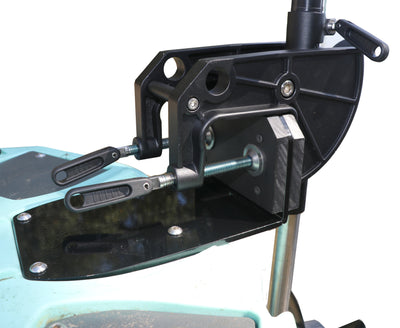
A pedal-drive unit, like the Zulu system, is typically installed in the center of the kayak. This placement helps distribute weight evenly. Unlike a trolling motor mounted on the bow or stern, a pedal-drive keeps its weight right under you.
An evenly weighted kayak tracks straighter and feels more predictable, especially in wind or currents. It responds to your movements without the tipping sensation that an unbalanced load can cause.

A Stable Platform for Activities
A major benefit of enhanced stability is the freedom it gives you to move around. For anglers, this means you can stand up to cast or sight fish with greater confidence.
Even for recreational kayakers, extra stability is noticeable. You can reach for your water bottle, grab a camera to capture a perfect shot, or simply shift your position for comfort without causing the kayak to rock. This creates a much more relaxing and enjoyable experience on the water.
Hands-Free Operation
One of the greatest advantages of a pedal-drive system is that it frees up your hands. When you use a traditional paddle, your hands are always occupied. With a pedal-drive kayak, your feet handle the propulsion, which leaves your hands free for other tasks.
For anglers, it means you can manage your fishing rod, change lures, or reel in a catch while keeping your position. You can also hold onto the sides of the kayak or a grab bar if you need extra support.
Better Control in Wind and Current
Navigating in wind or current can be a real test of a kayak's stability and your skills as a paddler. Using a standard paddle means constantly alternating between paddling to move forward and adjusting to steer. This back-and-forth motion can disrupt the stability of your kayak.
A pedal-drive system, which often includes an integrated rudder controlled by a hand lever, separates propulsion from steering. You can continuously pedal forward while making fine-tuned steering adjustments. This gives you precise control, which helps you hold your line in a crosswind or navigate a current without losing your balance.

Reduced Body Movement
As mentioned, paddling with your arms involves a lot of upper body rotation. Your torso twists, your shoulders move, and your weight shifts with every stroke. While experienced paddlers learn to manage this, these movements can still contribute to instability.
Pedaling, on the other hand, is a much more contained motion. Your core is stable, and your movements are focused below your waist. This reduction in upper body movement leads to a steadier kayak.
Confidence in Varied Conditions
Knowing your kayak is stable gives you the confidence to venture into different types of water. Even when the water gets a little choppy, you'll find it easy to handle in this kayak, something that might seem daunting in a less steady boat.
With systems like the Zulu pedal-drive, you’ll feel at ease navigating open water or fishing in busy areas with heavier boat traffic. The added stability gives you the confidence to explore further and embrace new challenges. When your gear is reliable, there’s no limit to the adventures you can take on.
How the Zulu System Is Different
What sets the Zulu pedal-drive apart is its design. It's built to be robust yet lightweight, which stabilizes the kayak without adding unnecessary bulk. The system integrates seamlessly into the hull, which helps keep a low profile and adequate center of gravity.
The mechanics of the Zulu drive are engineered for smooth and efficient power transfer. This means you don't have to pedal with jerky or abrupt motions, which further contributes to a steady ride.
The Zulu Advantage on the Water
When you put all these elements together—a lower center of gravity, hands-free operation, reduced body movement, and precise control—the outcome is a kayak that feels exceptionally stable. The Zulu pedal-drive works in harmony with the kayak's design to create a platform that inspires confidence.
A Steadier Ride
Whether you’re taking the perfect shot of nature, casting a line, or just kicking back, a stable vessel lets you focus on the experience rather than staying upright. The arrival of pedal-drive technology has truly transformed balance on the water. As we’ve seen with the Zulu pedal-drive system, it offers incredible advantages like hands-free maneuvering and a lower center of gravity for enhanced kayak stability.
If you’re ready to experience that kind of control for yourself, head over to Kaku Kayak to explore our lineup. Our team is always here to answer questions and help you find the perfect watercraft for your next adventure. Don't hesitate to contact us if you need a recommendation!